

Key takeaways
- CRM implementations fail most often from lost user trust, and dirty data is what destroys that trust first, not bad software or weak training.
- The death spiral runs in four steps: bad data enters, reps stop trusting the CRM, reps stop updating it, and the data gets worse.
- Quoted CRM failure rates of 30 to 70 percent use inconsistent definitions, but Gartner puts the cost of poor data quality at $12.9 million per year.
- When executives route around the CRM with manual roll-ups, they signal the system is optional and reinforce the spiral they should be breaking.
- Break the loop in order: deliver a visible quality win first, add process guardrails second, and bring in tooling third.
You bought the CRM, ran the training, and set the mandate that every deal lives in the system. Six months later, half your reps still run their pipeline out of a spreadsheet. Leadership calls it an adoption problem and books more training. The training does not work, because adoption was never the real problem.
The real problem is trust. Reps stop using a CRM when they stop believing what it tells them, and they stop believing it when the data inside is wrong. Bad data is not a side effect of low adoption. It is the cause.
What is the most common reason CRM implementations fail?
The most common reason CRM implementations fail is loss of user trust, and dirty data is what destroys that trust first. When reps see duplicate accounts, stale contacts, and blank fields, they conclude the system is unreliable and quietly return to their own spreadsheets. Every hour they spend outside the CRM makes the shared data worse, which erodes trust further. Poor data quality sets off a self-reinforcing spiral that no amount of training or executive mandate reverses on its own.
The dirty data death spiral
Failed CRM projects rarely die from one bad decision. They die from a loop that feeds itself. It runs in four steps.
- Bad data enters the system. Duplicates from a bulk import, stale contacts nobody updated, deals with no close date, phone fields full of “n/a.” The starting mess comes from a migration, a careless integration, or years of no standards.
- Reps stop trusting the CRM. A rep pulls up an account and finds two versions with different owners. Another calls a number that has been dead for a year. After a few of these, reps decide the system cannot be trusted for anything that matters.
- Reps stop updating it. Why invest careful effort in a system you do not trust? Reps do the bare minimum to satisfy the mandate and keep the real work in personal spreadsheets and their own heads.
- The data gets worse. With reps disengaged, records go stale faster, new duplicates pile up, and fields that were once complete rot. The system is now measurably worse than it was in step one.
Then the loop restarts, tighter each time. Worse data produces less trust, less trust produces less input, and less input produces worse data. This is the death spiral. It is slow, it is quiet, and by the time leadership names it an adoption crisis, the CRM has already become a place where good data goes to die.
The dangerous part is how reasonable each step looks from the inside. No one decides to abandon the CRM. Every rep is making a rational call about where to spend limited time. The spiral is the sum of many sensible individual choices, which is exactly why more training does not fix it. Training addresses behavior. The spiral is driven by data.
What the failure-rate numbers really say
CRM failure statistics get quoted with a confidence the sources do not support. You will see claims that 30 percent of projects fail, 50 percent, even 70 percent. Treat all of these with caution.
Published estimates of CRM project failure rates range widely, from around 30 percent to as high as 70 percent, depending on how failure is defined. Some studies count a project as failed if it misses ROI targets. Others count abandonment, low adoption, or budget overruns. The definitions rarely match, so the numbers rarely mean the same thing. Anyone who cites a single precise failure rate as settled fact is overstating what the research shows.
What is better established is the cost of the underlying problem. Gartner estimates that poor data quality costs organizations an average of $12.9 million per year. That figure covers the operational drag of bad data across the business, and CRM is where a large share of that drag shows up: wasted rep hours, misrouted leads, marketing sent to dead addresses, and forecasts built on numbers no one believes.
So the honest framing is this. The exact share of CRM failures caused by data is not something you can source to a clean statistic. But the mechanism is clear, the cost of bad data is well documented, and the pattern repeats across enough failed rollouts to be predictable. You do not need a precise percentage to recognize the spiral in your own org.
How the spiral shows up, team by team
The death spiral does not announce itself. It shows up as a set of familiar complaints that most leaders treat as separate issues. They are not separate. They are the same rot surfacing in different departments.

| Team | What they say | What is actually happening |
|---|---|---|
| Sales | “The CRM is slow and the data is always wrong, so I keep my own list.” | Reps have opted out. Their pipeline lives outside the system, so the CRM only ever sees a partial, stale picture. |
| Marketing | “Our campaigns bounce and lead routing sends the same account to two reps.” | Duplicates and dead contacts are inflating list sizes and breaking routing. Spend goes to records that cannot convert. |
| Service | “We call customers by the wrong name or quote them the wrong contract.” | Stale and conflicting records mean agents act on outdated facts, which damages relationships at the worst possible moment. |
| Leadership | “I do not trust the forecast, so I ask for a manual roll-up before every board meeting.” | The dashboard is built on data no one maintains. Executives quietly route around the CRM, which signals to everyone that the system is optional. |
Read that leadership row again, because it is where the spiral becomes fatal. When executives stop trusting the CRM enough to run the business from it, they send an unmistakable message down the org: the system does not count. Every rep watching leadership work from side spreadsheets learns that their own shortcuts are fine. The people with the most authority to break the spiral end up reinforcing it instead.
Notice that none of these complaints sound like a data quality problem on the surface. They sound like a software problem, a training problem, or a discipline problem. That misdiagnosis is why organizations keep spending on the wrong fixes. New CRM, new training vendor, new mandate, same spiral.
Breaking the spiral
You break a self-reinforcing loop by attacking the step that feeds it, and in this spiral that step is data reps do not trust. The sequence that works runs in one direction: visible quality wins first, process second, tooling third.
Visible quality wins first. Trust does not come back through a memo. It comes back when a rep opens the CRM and the account in front of them is right. Pick a slice that matters to the people you most need back, often the top accounts for your most vocal reps, and get that data clean and correct. Then show them. Early, visible correctness is what interrupts the “I do not trust this” step of the loop.
Process second. Once trust starts to return, put the guardrails in place that keep new bad data out: ownership rules, required fields that actually matter, import standards, and a clear owner for each critical object. Do this before reps are re-engaged and it feels like bureaucracy. Do it after the first trust win and it feels like protecting something worth protecting.
Tooling third. Tools do not fix a trust problem, but they make quality durable once the first two steps have earned back attention. The job of tooling here is narrow and important: keep data quality measurable and visible so it never silently rots again.
The order matters more than any single step. Lead with tooling and you automate a system no one trusts. Lead with process and you add friction to a system people are already fleeing. Lead with a visible quality win and you give reps a reason to look again, which is the only thing that stops the spiral from restarting.
Making quality visible
The reason the death spiral runs unseen for so long is that data quality has no obvious readout. Your org has a number for pipeline, a number for closed revenue, and a number for support backlog. It has no number for whether the data behind all of those is any good. Quality rots in the dark because no one is looking at a gauge.
That is the gap Data Quality Sense (DQS) is built to close. DQS is a Salesforce-native app that scans your records and turns their quality into a single score from 0 to 100, weighted across completeness, validity, uniqueness, timeliness, and consistency. Instead of arguing about whether the data is “bad,” you get a number everyone can see and a breakdown of exactly which fields and objects are dragging it down.
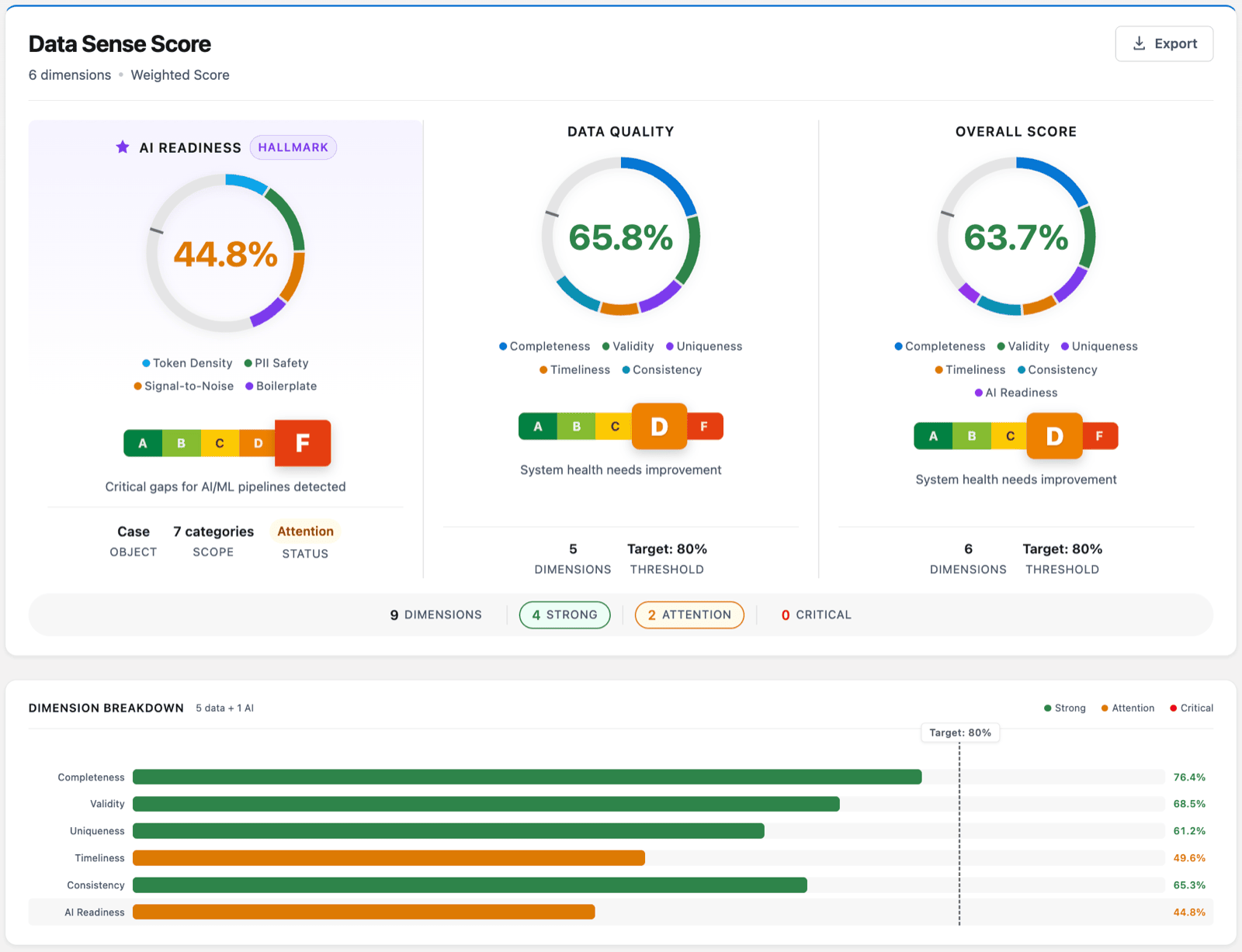
The visibility is what changes behavior. When the score is on a dashboard leadership actually watches, “clean the data” stops being a vague virtue and becomes a target with a number attached. DQS tracks that score over time, so a cleanup effort shows up as a trend line moving up, and a neglected object shows up as a trend line sliding down before it becomes a crisis.
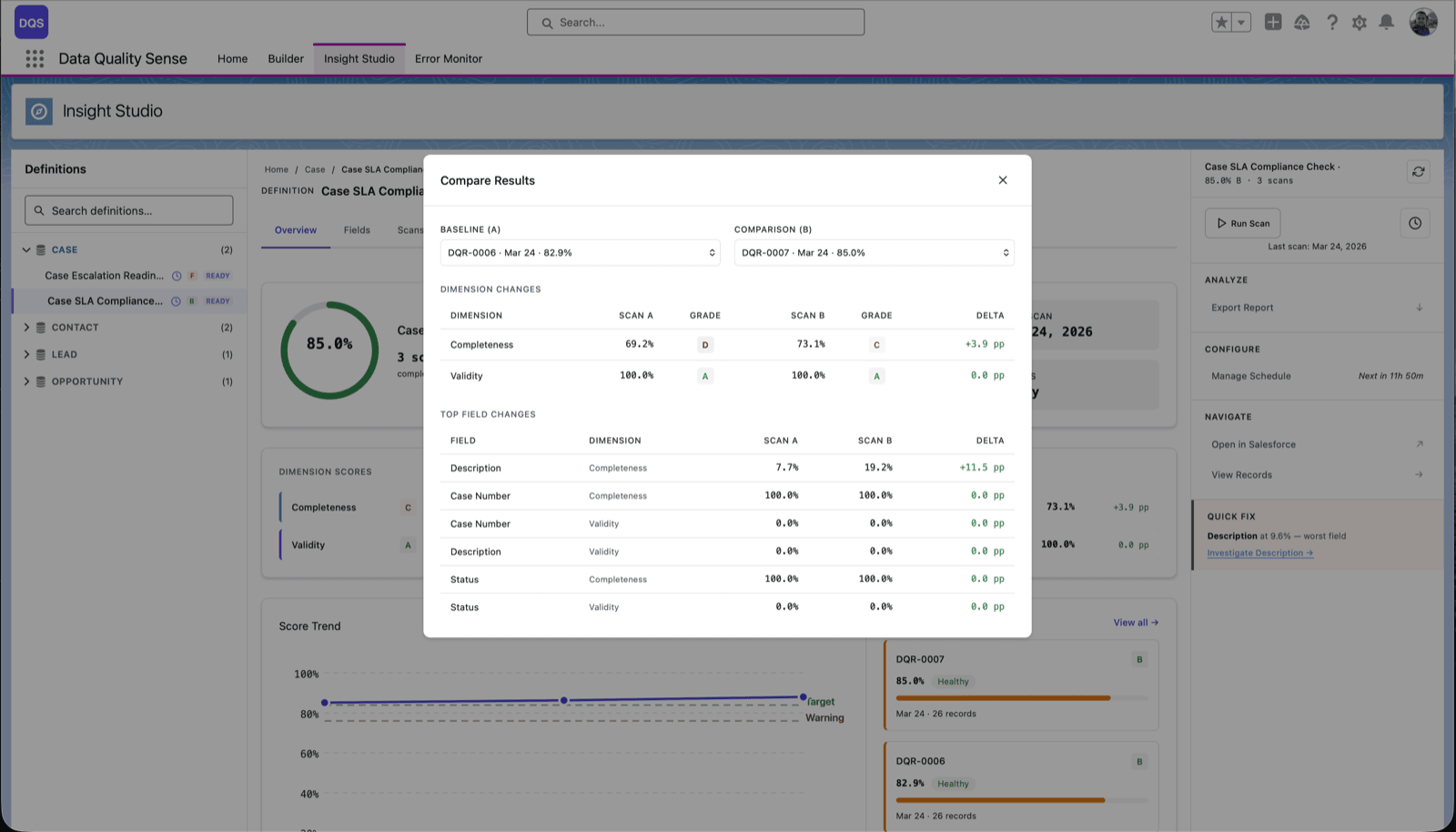
That is the practical antidote to the spiral. A visible score gives you the early quality win reps can see, scan comparison proves the cleanup worked, and the trend line keeps quality honest long after the project energy fades. DQS does not update records for you or merge duplicates on its own. It does something the spiral cannot survive: it makes the state of your data impossible to ignore.
CRM adoption was never really about training. It was about whether people trust what the system tells them. Fix the data, make its quality visible, and adoption stops being a battle you fight every quarter.
Keep reading
- What is a data quality score?: how the 0-100 weighted score is calculated and what it measures.
- Building a data quality culture: turning visible quality into habits that stick.

Michał Bajdek
Co-Founder, Data Quality Sense
Salesforce Architect and AppExchange ISV founder focused on optimizing enterprise workflows. Certified System and Identity Architect who previously built Salesforce solutions at Accenture, PwC and IBM’s Waeg.