

Key takeaways
- Gartner projects 60% of AI projects without AI-ready data will be abandoned through 2026, and MIT found roughly 95% of GenAI pilots deliver no P&L impact.
- The assessment is 20 yes/no questions across six dimensions: completeness, validity, uniqueness, timeliness, consistency, and PII safety.
- Score each dimension red, yellow, or green: all six green means build, any yellow means fix or scope down, any single red blocks the pilot.
- Assess only the fields your AI use case actually reads, not the whole org, because readiness is scoped to the data path the AI touches.
- Replace opinions with measured numbers before signing off a dimension as green; a scan of real records beats a survey of hopeful answers.
Most AI projects start with the model and end with the data. The team picks a use case, wires up an agent, runs a clean demo, and only discovers the state of the underlying records once real users hit real production data. By then the fix is expensive and the timeline is already public.
The order is backwards. The data decides whether the project works long before the model does. An assessment up front costs a few hours. Skipping it costs the pilot.
This post gives you that assessment: 20 questions your team can answer in a room, grouped by the data quality dimension each one tests, plus a scoring rubric that tells you whether you are clear to build. It is deliberately free of tooling and jargon. You can run it against any Salesforce org today.
Why AI projects skip the data audit
Data audits get skipped because they feel like a delay, and the demo already worked. The demo ran on curated records that someone cleaned by hand. Production runs on the account nobody has touched since 2019, the duplicate contact with two email addresses, and the notes field with a Social Security number pasted into it. The model is identical in both. The ground underneath is not. (For the full failure taxonomy, see why AI agents fail in production.)
The numbers back this up. Gartner projects that through 2026, organizations will abandon 60% of AI projects that are not supported by AI-ready data. MIT’s 2025 study “The GenAI Divide” found that roughly 95% of GenAI pilots deliver no measurable P&L impact. A short readiness check will not guarantee the other 5%, but skipping it reliably lands you in the 95%.
How do you assess data readiness for AI?
You assess data readiness for AI by scoring your records against the same quality dimensions that decide whether an agent can trust them: completeness, validity, uniqueness, timeliness, consistency, and PII safety. For each dimension, ask whether the specific fields your AI use case depends on meet a defined bar, then rate the answer red, yellow, or green. A use case is ready when every dimension it relies on scores green, and it is blocked when any single dimension scores red. Assess the fields the use case actually reads, not the whole org, because readiness is scoped to the data path the AI touches.
The dimensions are the practical version of the “C’s of data quality” you will see in enterprise frameworks (complete, correct, consistent, current). The questions below turn them into something a team can answer in a single working session.
The 20 questions
Answer each question yes, no, or partially for the specific object and fields your AI use case reads. Score honestly. “Partially” is not a pass.
Completeness (does the AI have the data it needs to answer?)
- Do the fields your use case depends on have a value in at least 95% of the records the AI will read?
- Are the records with missing critical fields identified, counted, and reviewed rather than assumed to be rare?
- Do “empty” fields include placeholder junk (N/A, TBD, ., xxx, unknown) that looks filled but carries no information?
- Can you name every field the AI must read, and confirm each one is populated for the population it will run against?
Validity (is the data in a shape the AI can use?)
- Do email, phone, and URL fields pass a format check for the records in scope?
- Are structured values (currencies, codes, IDs) stored in a single consistent format rather than several free-text variations?
- Do you know your invalid-format rate per field, or is it currently unmeasured?
Uniqueness (will duplicates make the AI contradict itself?)
- Have you measured the duplicate rate on the object the AI reads, rather than assuming duplicate rules keep it low?
- Would the AI encounter two records for the same real-world entity with conflicting values?
- Are existing duplicates (the ones already in the org before any rule was switched on) accounted for, not just new inserts?
Timeliness (is the data current enough to act on?)
- Do you know the age distribution of the records in scope, based on a date field that reflects real activity?
- Would the AI read records that have not been updated inside the window your use case requires (for example, entitlements, pricing, or ownership)?
- Is there a defined freshness threshold per field, or does “old” have no agreed meaning yet?
Consistency (does the same thing mean the same thing everywhere?)
- Do picklist and category fields conform to a single dominant standard, or do they hold drifting free-text variants of the same value?
- Are the same units, currencies, and formats used across all records the AI compares?
- Would two records that should agree (parent and child, related accounts) present conflicting values to the AI?
PII and safety (will the AI expose data it should not?)
- Have you scanned free-text and description fields for Social Security numbers, credit card numbers, emails, and phone numbers sitting where they do not belong?
- Do you know which fields carry PII, so the AI’s retrieval scope can exclude or protect them?
- Is sensitive data kept out of the fields the AI reads and grounds its answers on?
- Can you produce a redacted record of what PII exists and where, for compliance review before launch?

Scoring rubric: red, yellow, green
Score each of the six dimensions, not each question. Count the answers inside the dimension and apply the rubric below.
| Rating | Answers in the dimension | What it means | Action |
|---|---|---|---|
| 🟢 Green | All yes | The data path clears the bar for this dimension | Cleared to build against this dimension |
| 🟡 Yellow | Any partially, no no | Known gaps you can size and plan around | Fix or scope down before launch |
| 🔴 Red | Any no | An unmeasured or failing dimension the AI will inherit | Blocked until measured and raised to yellow or green |
Then roll the six dimension ratings into one project verdict:
- All six green: ready. Build the use case as scoped.
- Any yellow, no red: conditional. Ship only after you close the yellow gaps or narrow the use case to the data that is green.
- Any red: not ready. A single red dimension is enough to stall a pilot, because the AI acts on individual records and one bad record is one bad action.
The rubric is deliberately strict. Analytics averages bad data away; an agent acts on the single record in front of it. Grade accordingly.
From questionnaire to evidence
The questions above are only as honest as your answers. “We think completeness is fine” is a guess, and guesses are what put the 95% in the MIT figure. Before you sign off a dimension as green, replace the opinion with a measured number.
This is where a scan matters more than a survey. Data Quality Sense (DQS) is a Salesforce-native app that turns each question in this checklist into a measured result against your real records. It runs as a batch scan on any SObject you point it at, and reports what it finds. It does not cleanse, merge, or fix records for you, and it does not run on save. It measures, scores, and surfaces the evidence so your yes/no answers rest on data instead of hope.
The six dimensions in this assessment map directly to what DQS measures:
| Assessment dimension | DQS capability | What the scan returns |
|---|---|---|
| Completeness | Completeness | NULL, blank, empty, and placeholder rate per field |
| Validity | Format Validation | Format pass rate for email, phone, and URL fields |
| Uniqueness | Basic Uniqueness | Duplicate count and distinct count on the object |
| Timeliness | Data Freshness | Record age against a date field and your threshold |
| Consistency | Conformance Check | Rate of records matching the dominant standard |
| PII and safety | PII Safety | SSN, credit card, email, and phone detected in STRING and TEXTAREA fields |
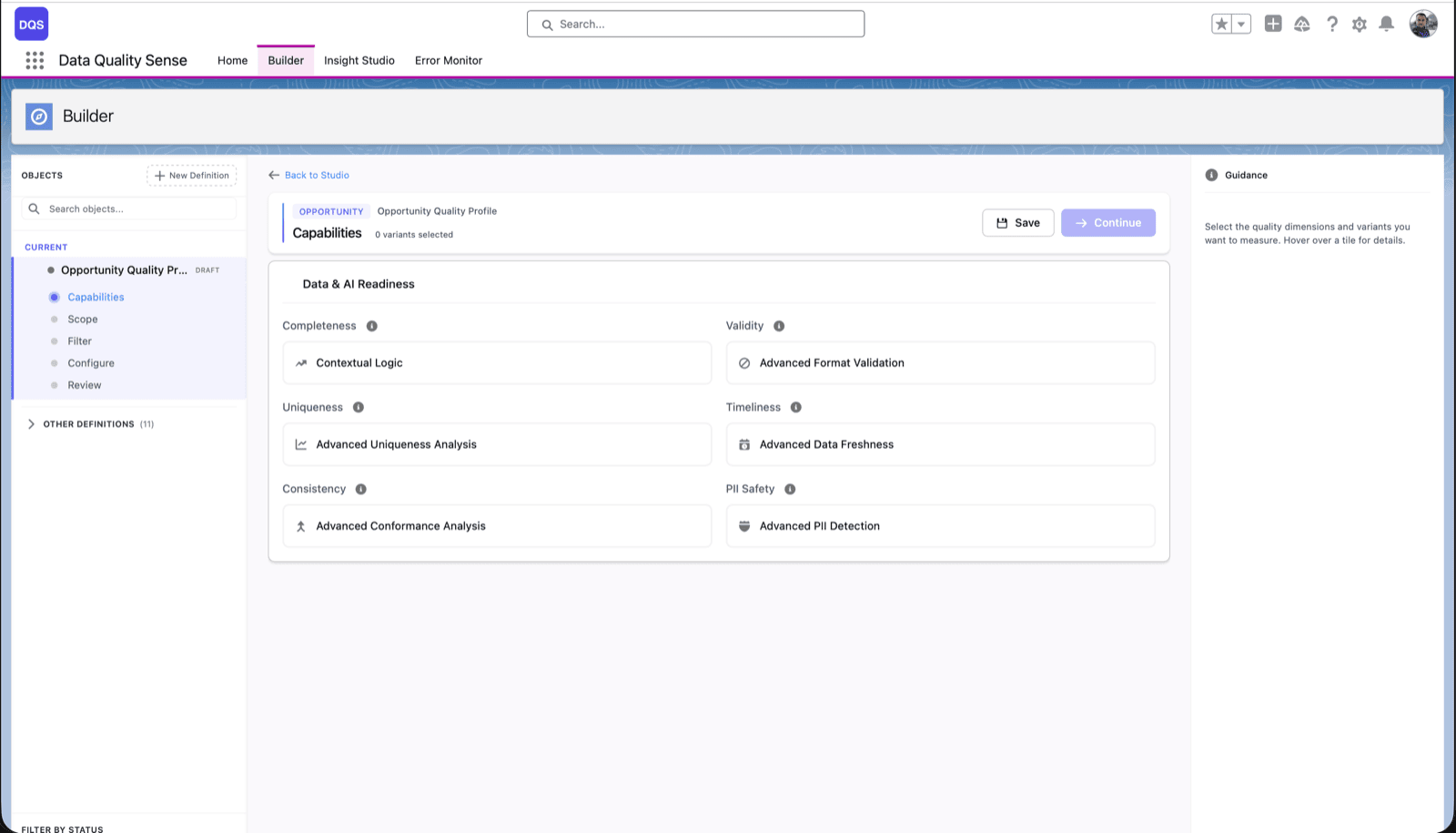
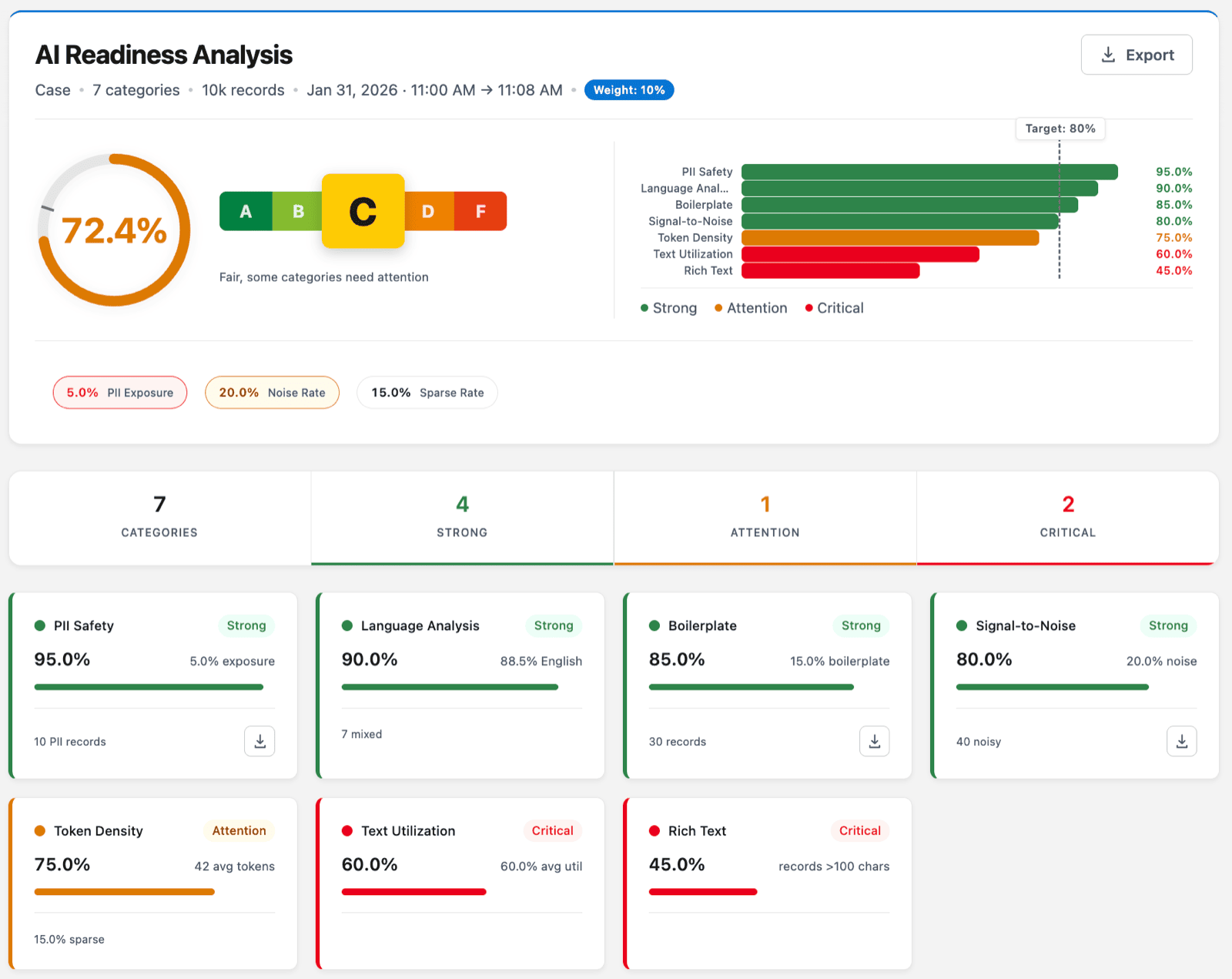
In DQS Builder, you select the object, pick the AI Readiness capabilities, and set the threshold per field that matches the bar you defined in the rubric. The scan runs, and Insight Studio returns the score per dimension so you can rate each one red, yellow, or green with a number behind it. PII values stay redacted ([REDACTED]) in every export, so you can hand compliance the evidence without handing them the exposure.
What “ready” looks like
Ready is not a perfect org. Ready is a scoped data path where every dimension the use case depends on has been measured and clears a threshold you set on purpose. A support agent reading entitlement records needs green timeliness and green PII safety far more than it needs a spotless picklist somewhere else in the org. Define the bar per field, measure against it, and let the green/yellow/red verdict decide the launch.
Run the 20 questions before you write a line of agent logic. Fix the reds, close the yellows, and keep the scan on a schedule so the score you launched with is the score you keep. The teams that clear this gate first are the ones whose pilots survive contact with production data.
Want the measured version of this checklist against your own org? Take the interactive AI readiness assessment, and pair it with the Agentforce data readiness checklist to turn each answer above into evidence you can act on.

Artur Kolasa
Co-Founder, Data Quality Sense
Salesforce Certified Technical Architect helping global enterprises turn business goals into scalable Salesforce strategies. A decade of delivery and architecture leadership across Accenture, PwC, IBM’s Waeg and Publicis Sapient.